
Picture your nonprofit’s finances as a building. For years, the lights work, the doors open, the heat comes on when it should. Everything seems fine. Then one Tuesday morning, a foundation officer emails: “We loved your application. Please send your most recent audited financial statements.”
That email is a smoke detector going off and most nonprofits realize, in that exact moment, that they’ve never actually installed one.
An audit is not a punishment. It’s not paperwork. It’s the smoke detector for your mission. The question isn’t whether nonprofits should care about audits; it’s recognizing the seven specific moments when the alarm starts blinking red.
If any of the scenarios below sound like your organization right now, keep reading. You’re closer to needing an audit than you think.
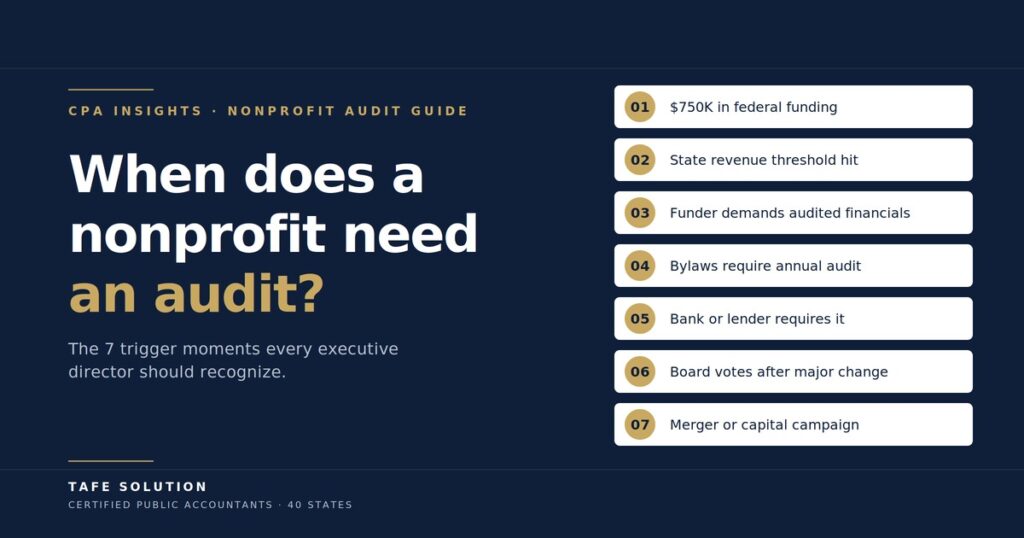
A nonprofit needs an audit when one of the following triggers applies:
- It receives $750,000 or more in federal funding in a fiscal year (Single Audit / Uniform Guidance requirement).
- Its state of registration mandates one based on revenue thresholds often between $250,000 and $1 million in gross revenue. (See our Nonprofit Audit Requirements by State for the full breakdown.)
- A grantmaker, foundation, or major donor requires audited financials as part of their due diligence.
- The organization’s bylaws require periodic independent audits.
- A bank or lender requires audited statements to issue credit, a line of credit, or a mortgage.
- The board of directors votes for one (often after leadership turnover, rapid growth, or a fraud concern).
- The nonprofit is preparing for a merger, dissolution, capital campaign, or major expansion.
If none of those apply, your nonprofit may instead need a financial review or compilation both lighter, less expensive alternatives that still produce a CPA-signed report. You can compare all three side-by-side on our CPA assurance services page.
The 7 Trigger Moments – In Plain English
The Federal Funding Cliff: $750,000
Think of $750,000 as the federal government’s velvet rope. Cross it in a single fiscal year, and you walk into a different room entirely. That room is called the Single Audit (formally, an audit under the Uniform Guidance, 2 CFR Part 200).
This isn’t a regular nonprofit audit. A Single Audit examines not just your financial statements but how you spent every federal dollar – program by program, grant by grant. Miss it, and you risk losing federal eligibility, having funds clawed back, or being flagged on the Federal Audit Clearinghouse for the world to see.
Imagine this: A youth literacy nonprofit in Ohio runs on $620,000 in private donations and a single $180,000 federal pass-through grant. Total federal expenditure: $180,000. They’re below the threshold. Then they win a second federal grant for $590,000. Suddenly they’ve crossed $750,000, and they have nine months from fiscal year-end to deliver a Single Audit. The clock starts the day they accept the grant, not the day they realize what they’ve signed up for.
The State Line You Can’t See
Every state writes its own audit rulebook for nonprofits, and the lines are not where you’d expect.
- California requires an audit for nonprofits with $2 million or more in gross revenue.
- Florida triggers a financial review at $500,000 in contributions and a full audit at $1 million.
- Massachusetts triggers a review at $500,000 and a full audit at $1,000,000.
- New York triggers a full audit at $1 million.
If your organization is registered to solicit donations in multiple states (and most nonprofits with online donate buttons technically are), you may be answering to several rulebooks at once. The state where you’re incorporated is rarely the only state that matters.
The Grantmaker’s Quiet Test
Here’s a truth that doesn’t get said often enough: most foundations don’t tell you they need an audit until you’re three rounds deep in their application process. By then, you’ve invested fifteen hours in narrative writing and pulled letters of support – only to be told that audited financials are a “standard requirement” they assumed you had.
If your nonprofit is chasing five-figure grants, you can probably get away with a financial review or a CPA-prepared compilation. If you’re chasing six and seven figures, assume an audit is coming, and get ahead of it.
The cost of being audit-ready before a grant cycle is always lower than the cost of scrambling during one.
Your Own Bylaws Are Telling You
Pull up your articles of incorporation and bylaws right now. (Yes, right now)
Plenty of nonprofit bylaws include a clause requiring an annual independent audit, and somewhere around year three, it quietly stops happening. New leadership often has no idea the requirement was ever there in the first place. Boards turn over. The line item disappears from the budget.
If your bylaws say “audit,” you are out of compliance with your own governing documents the moment you skip one. That’s a compliance gap that tends to surface at the worst possible time (during a grant review, a new board member’s onboarding, or due diligence for a merger).
The Banker Who Holds the Keys
Nonprofits borrow money. They take out lines of credit to bridge grant disbursements. They mortgage buildings. They finance vehicles for delivery routes, equipment for clinics, technology for schools.
Banks lending to nonprofits almost always want audited financial statements: not a Form 990, not a QuickBooks export, not your treasurer’s spreadsheet. The level of assurance an audit provides is what makes a loan officer’s underwriting committee comfortable saying yes.
The Board That Needs to Sleep at Night
Sometimes the trigger isn’t external. Sometimes it’s the slow, quiet realization around a board table that nobody in the room actually knows whether the numbers are right.
This happens after:
- An executive director retires or is terminated.
- A bookkeeper leaves abruptly.
- A whistleblower complaint or anonymous tip lands in someone’s inbox.
- The organization grows from $400K to $1.4M in three years and the controls didn’t grow with it.
- A merger conversation begins.
- An insurance audit, IRS notice, or media inquiry surfaces.
A board’s fiduciary duty isn’t satisfied by good intentions. When the board votes for a voluntary audit, they are doing the most boring, most powerful thing they can do: replacing trust with verification.
If your books haven’t been touched in twelve months and an auditor walking in the door right now would find chaos, start with book cleanup and catch-up accounting before you engage an auditor. It’s far cheaper to clean the kitchen yourself than to have a chef do it at chef rates.
The Big Move
Mergers. Dissolutions. Capital campaigns. New affiliate offices. Spinning off a subsidiary 501(c)(3). Selling a building.
Every “big move” in a nonprofit’s life cycle requires a clean financial baseline. An audit produces that baseline. Without one, the merger conversation stalls, the capital campaign stumbles at the lead-gift stage, and the dissolution lawyer asks for documents you can’t produce in time.
This is also the moment where nonprofits discover that their financial statements aren’t actually GAAP-compliant; they were sufficient for internal use, but not for the kind of scrutiny a major transaction brings. Our financial statement preparation service gets you to GAAP-ready before the audit fieldwork begins.
Your 5-Minute Self-Check
Answer these honestly:
- Did you spend (or will you spend) $750,000+ in federal funds this fiscal year?
- Is your gross revenue above your state’s audit threshold? (Check our state guide if you’re not sure.)
- Has any funder, lender, or grantor asked for “audited” financials in the last 12 months?
- Do your bylaws require an annual or periodic audit?
- Has your organization gone through leadership turnover, rapid growth, or a major incident in the last 18 months?
- Are you planning a merger, capital campaign, or major expansion in the next 24 months?
- Could your board chair confidently swear, in writing, that the financials presented at last month’s meeting are accurate?
If you answered yes to even one of questions 1–6, or no to question 7, your nonprofit is in audit territory. It’s time for a conversation not next quarter, not next fiscal year. This week.
How We Help Nonprofits Get Audit-Ready
We work with nonprofits across 40+ states to navigate exactly this question – do we need an audit, a review, or just clean books? and then deliver whichever service actually fits.
What we do differently:
- A free consultation to determine which level of assurance your organization actually needs (we don’t oversell audits to nonprofits that need a review or compilation).
- Audit-ready bookkeeping cleanup so your CPA isn’t billing you to fix three years of misclassified entries.
- CPA reports trusted by funders: the kind that don’t get kicked back during grant review.
- Virtual delivery in 40 states, so geography doesn’t dictate price.
If your nonprofit is approaching one of the seven trigger moments above or already inside one.
FAQs
At what revenue does a nonprofit need an audit?
There is no single federal revenue threshold. Most state thresholds fall between $250,000 and $2 million in annual gross revenue. The federal trigger is $750,000 in federal expenditures not total revenue.
Are nonprofits legally required to be audited?
Not all of them. A nonprofit is legally required to be audited only when (a) it spends $750,000+ in federal funds in a fiscal year, (b) its state of registration mandates one, or (c) its own bylaws require one. Many other audits are contractually required by grantmakers and lenders, which is functionally the same thing.
How often does a nonprofit need an audit?
When required, audits are typically performed annually, covering each completed fiscal year. Some smaller organizations conduct audits every two or three years if their bylaws and funders allow it.
What’s the difference between a nonprofit audit and an IRS audit?
A nonprofit financial audit is a voluntary or contractually required examination performed by an independent CPA firm. An IRS audit is an examination of tax filings (such as Form 990) initiated by the IRS itself. The two are unrelated in practice but often confused in conversation.
Can a nonprofit do its own audit?
No. To meet legal, grantmaker, and lender requirements, the audit must be performed by an independent CPA meaning the firm has no financial or governance ties to the nonprofit. Internal reviews by staff or board members can supplement an audit but never replace one.
How long does a nonprofit audit take?
From engagement letter to final report, expect 6 to 12 weeks for a well-prepared organization. Add another 4 to 8 weeks if your books require cleanup or catch-up accounting before fieldwork begins.
The Bottom Line
A nonprofit doesn’t need an audit because the IRS is coming. It needs an audit because somewhere — in a grantmaker’s inbox, a banker’s underwriting file, a state attorney general’s database, or a board chair’s quiet 2 a.m. worry — someone is about to ask, “Can you prove these numbers are real?”
The right answer to that question is a CPA-signed audit report on the table before they finish asking.
The wrong answer is a scramble.
Choose the timeline that protects your mission.